Redesigning for One Church in Eight Countries
Redesigning for One Church in Eight Countries
How Can We Restructure a Church Website to Serve All Her Parishes as One?
How Can We Restructure a Church Website to Serve All Her Parishes as One?

Overview
Overview
This project, commissioned by the Bishop of Western Europe, is a follow-up to the Mar Benyamin website. It brings 10 parishes together into one holistic, central website — with new features, translated content, and distinct styling for each parish, built to serve church members across the diocese.
This project, commissioned by the Bishop of Western Europe, is a follow-up to the Mar Benyamin website. It brings 10 parishes together into one holistic, central website — with new features, translated content, and distinct styling for each parish, built to serve church members across the diocese.
Role
UI/UX Design
Information Architecture
Content Translation
Team
UX/UI Designer & Developer (Me)
Bishop of Western Europe
Tools
Figma
Subsplash
Facebook API
AI-Assisted Translation

Why
The current website for the Western Diocese – which covers 10 parishes across 8 countries – is mainly centred on the London parish, leaving the others with incomplete pages and outdated details. To give every community its own proper platform, while still sharing one central identity, the site needed a reorganisation.
The current website for the Western Diocese – which covers 10 parishes across 8 countries – is mainly centred on the London parish, leaving the others with incomplete pages and outdated details. To give every community its own proper platform, while still sharing one central identity, the site needed a reorganisation.
What
The result is a centralized site sharing core content (Faith, History, Resources) across every parish, while staying distinct where it matters (Youth, Media, Contact). Each parish carries its own visual identity within the shared design system, and has its content written in its own regional language, with details relevant to its own community.
The result is a centralized site sharing core content (Faith, History, Resources) across every parish, while staying distinct where it matters (Youth, Media, Contact). Each parish carries its own visual identity within the shared design system, and has its content written in its own regional language, with details relevant to its own community.
How
Building on the Mar Benyamin project, I mapped out a restructured sitemap for the new site. It was then rebuilt in Subsplash with new features and layout changes throughout, and some hard-coded pieces carried over directly from the Mar Benyamin site.
Building on the Mar Benyamin project, I mapped out a restructured sitemap for the new site. It was then rebuilt in Subsplash with new features and layout changes throughout, and some hard-coded pieces carried over directly from the Mar Benyamin site.
INFORMATION ARCHITECTURE
Restructuring the map
Restructuring the map
Restructuring the map
The core problem was this: how could the website treat every parish equally, while still sharing some features and keeping others distinct? To work out what should be shared and what should stay unique to each parish, I mapped out two flowcharts — one for the current site, one for a possible new structure.
The core problem was this: how could the website treat every parish equally, while still sharing some features and keeping others distinct? To work out what should be shared and what should stay unique to each parish, I mapped out two flowcharts — one for the current site, one for a possible new structure.
The core problem was this: how could the website treat every parish equally, while still sharing some features and keeping others distinct? To work out what should be shared and what should stay unique to each parish, I mapped out two flowcharts — one for the current site, one for a possible new structure.

The restructure changed things in four key ways:
Parish selection happens once — previously repeated three separate times across Services, Youth, and Children; now it's a single click
General vs. Parish-Specific split — shared content (About, Resources, Store) separated from what's unique per parish
Language handled independently — with the parish selection, the language is automatically translated into the respective regional language
Fewer, clearer top-level categories — Services/Youth/Children consolidated into one Parish branch, reducing redundant navigation
The restructure changed things in four key ways:
Parish selection happens once — previously repeated three separate times across Services, Youth, and Children; now it's a single click
General vs. Parish-Specific split — shared content (About, Resources, Store) separated from what's unique per parish
Language handled independently — with the parish selection, the language is automatically translated into the respective regional language
Fewer, clearer top-level categories — Services/Youth/Children consolidated into one Parish branch, reducing redundant navigation
DESIGN & IMPLEMENTATION
Select Your Parish
Select Your Parish
Rather than simply listing parishes by name and location, I built a more interactive, central component to guide visitors to their own parish. It's the first thing a visitor sees — a welcome, before any other content. Before landing on their own page, they see that they're part of a larger community.
Rather than simply listing parishes by name and location, I built a more interactive, central component to guide visitors to their own parish. It's the first thing a visitor sees — a welcome, before any other content. Before landing on their own page, they see that they're part of a larger community.
Different Color, Same Identity
Different Color, Same Identity
Different Color, Same Identity
Colour plays another role in giving each community a sense of autonomy while still belonging to one diocese. Every parish shares the same heritage — but each carries its own primary colour, reflected consistently across the site itself.
Colour plays another role in giving each community a sense of autonomy while still belonging to one diocese. Every parish shares the same heritage — but each carries its own primary colour, reflected consistently across the site itself.
Colour plays another role in giving each community a sense of autonomy while still belonging to one diocese. Every parish shares the same heritage — but each carries its own primary colour, reflected consistently across the site itself.




Multilingual Content
Multilingual Content
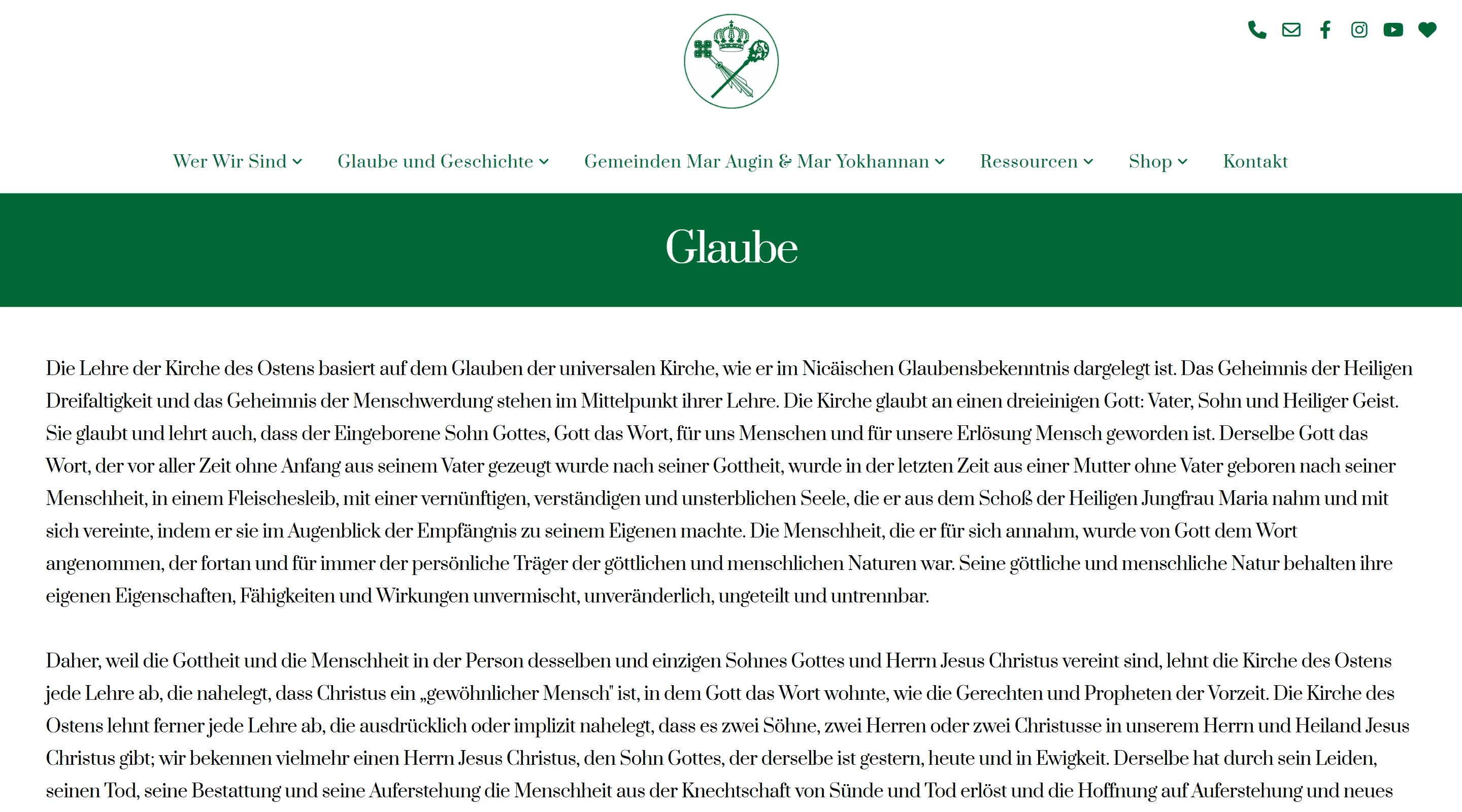
The Assyrian diaspora spans many countries, and with it, many regional languages. To make the site genuinely usable for each community — whether reading the parish's history or checking service times — every page is translated into that parish's own language. The site currently supports French, Dutch, German, and Greek. The Readings feature carried over from Mar Benyamin, too — the same basis, now translated for each parish.
The Assyrian diaspora spans many countries, and with it, many regional languages. To make the site genuinely usable for each community — whether reading the parish's history or checking service times — every page is translated into that parish's own language. The site currently supports French, Dutch, German, and Greek. The Readings feature carried over from Mar Benyamin, too — the same basis, now translated for each parish.
The Assyrian diaspora spans many countries, and with it, many regional languages. To make the site genuinely usable for each community — whether reading the parish's history or checking service times — every page is translated into that parish's own language. The site currently supports French, Dutch, German, and Greek. The Readings feature carried over from Mar Benyamin, too — the same basis, now translated for each parish.
Live from the Parish
Live from the Parish
To engage parishioners further and give each site a sense of life, the home page displays imagery from the parish's most recent activity — pulled automatically from their Facebook page using the Facebook Graph API, and shown as a featured banner on the first page. It's built with ease of use in mind: parishes simply keep posting to Facebook as they already do, and the site updates itself. The result is a site that feels personal and communal, without adding any extra work for the parish.
To engage parishioners further and give each site a sense of life, the home page displays imagery from the parish's most recent activity — pulled automatically from their Facebook page using the Facebook Graph API, and shown as a featured banner on the first page. It's built with ease of use in mind: parishes simply keep posting to Facebook as they already do, and the site updates itself. The result is a site that feels personal and communal, without adding any extra work for the parish.
To engage parishioners further and give each site a sense of life, the home page displays imagery from the parish's most recent activity — pulled automatically from their Facebook page using the Facebook Graph API, and shown as a featured banner on the first page. It's built with ease of use in mind: parishes simply keep posting to Facebook as they already do, and the site updates itself. The result is a site that feels personal and communal, without adding any extra work for the parish.
Facebook Post
Homepage Display
Facebook Post
Homepage Display


REFLECTION
Looking Back…
Looking Back…
If I did this again, I'd want to bring each parish's own community into the process directly — not just through the Bishop's review but by hearing from parishioners themselves what they'd want from their own site. Different communities have different needs, and that becomes clearer once the site is actually live and parishes start using it.
The multilingual header is probably what I'm most proud of technically. The plattform's support told me there wasn't a fixed way to do it, so I worked it out myself, filtering navigation URLs by language prefix (fr-, de-, nl-) to show each parish's menu in its own language.
For now, the site is complete and awaiting the Bishop's final approval before going public.
The multilingual header is probably what I'm most proud of technically. Subsplash's own support told me there wasn't a way to do it — so I worked it out myself, filtering navigation URLs by language prefix (fr-, de-, nl-) to show each parish's menu in its own language.
If I did this again, I'd want to bring each parish's own community into the process directly — not just the Bishop's review, but hearing from parishioners themselves about what they'd want from their own site. Different communities have different needs, and that becomes clearer once the site is actually live and parishes start using it.
For now, the site is complete and awaiting the Bishop's final approval before going public, awaiting the last round of contact details from each parish.
If I did this again, I'd want to bring each parish's own community into the process directly — not just through the Bishop's review but by hearing from parishioners themselves what they'd want from their own site. Different communities have different needs, and that becomes clearer once the site is actually live and parishes start using it.
The multilingual header is probably what I'm most proud of technically. The plattform's support told me there wasn't a fixed way to do it, so I worked it out myself, filtering navigation URLs by language prefix (fr-, de-, nl-) to show each parish's menu in its own language.
For now, the site is complete and awaiting the Bishop's final approval before going public.